Mobile Package Prices Increased by Up to 33% in Pakistan (2026)
Telecom consumers across Pakistan are facing a significant wave of tariff hikes this year. If you rely on daily, weekly, or monthly data and call bundles, your regular communication expenses are officially going up.
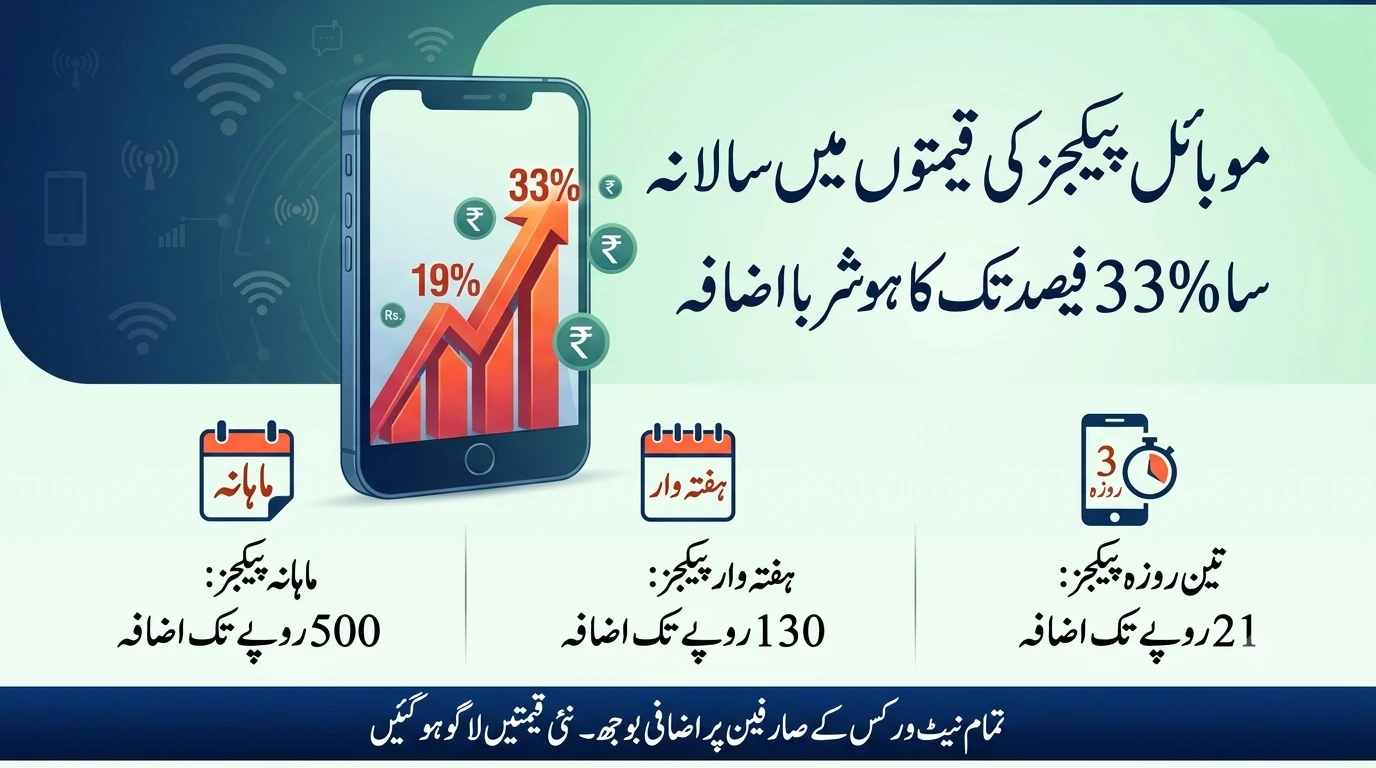
Recent updates confirm that mobile package prices have experienced a sharp annual increase ranging from 19% to 33%. This recent price adjustment impacts subscribers across all major cellular networks operating in the country.
With rising operational costs, heavy sector taxation, and inflation, telecom companies have passed the financial burden onto consumers. Monthly call and data packages have seen the highest jump, creating new challenges for low-income and heavy-data users alike.
In this article, we will break down the complete details of the newly issued package prices, updated durations, and the specific facilities provided. We will also explore the ongoing regulatory efforts to maintain transparency in this highly competitive market.
Detailed Breakdown of Package Price Hikes
The recent price revisions are not limited to just one type of user. Cellular companies have completely restructured the pricing of short-term and long-term connectivity bundles.
Complete details regarding the quarterly prices, package durations, and provided facilities have been officially released. Here is a close look at exactly how much extra you will be paying for your regular subscriptions.
Monthly Call and Data Packages
Monthly packages are the primary choice for most professionals, students, and home users. Unfortunately, they have taken the biggest financial hit in this recent tariff update.
Prices for premium monthly call and data packages have been increased by up to 500 rupees. This is a massive jump for consumers who prefer the convenience of recharging their accounts only once a month.
Subscribers will need to carefully review their monthly data usage. Sticking to older, heavy data plans might severely strain household budgets under the new 2026 pricing structures.
15-Day Telecom Packages
Bi-monthly or 15-day packages bridge the gap between weekly and monthly subscriptions. They are highly popular among prepaid users who manage their telecom budgets paycheck to paycheck.
The prices for 15-day call and data packages have now seen an increase of 300 rupees. This targeted hike means users will essentially be paying 600 rupees more per month if they renew this specific bundle twice.
Weekly Hybrid Packages
Weekly hybrid packages offer a balanced mix of off-net minutes, on-net calls, SMS, and internet data. They are heavily utilized by the youth and freelance professionals across the country.
These weekly hybrid bundles have been increased by 130 rupees. While it might seem smaller compared to the monthly hikes, a weekly increase of 130 rupees quickly adds up to over 500 rupees of extra spending per month.
Short-Term 3-Day and 2-Day Offers
Even the most affordable, short-term data and call solutions have not been spared from the ongoing inflation. These packages are critical for lower-income groups who recharge in small daily amounts.
The three-day mobile packages have been increased by 21 rupees. Similarly, the two-day mobile packages have seen a price bump of up to 20 rupees. While these numbers look small on paper, they represent a high percentage increase for budget-conscious consumers.
The Annual Impact: Why Tariffs Jumped by 19% to 33%
When you look at the telecom market on an annual basis, the numbers paint a difficult picture for consumers. The overall mobile package prices have surged by 19% to 33% year over year.
This is not a sudden, overnight decision by telecom operators. It is the result of compounding economic pressures over the last few quarters. The cost of maintaining network towers, importing equipment, and paying commercial electricity tariffs has forced operators to adjust their quarterly prices.
Every package’s quarterly price, duration, and facilities have been fully documented and updated. Companies are hoping that by releasing complete details, consumers can adjust their usage habits accordingly.
PTA Enhances Transparency for Telecom Consumers
With prices fluctuating rapidly, it can be hard to track exactly how much a package truly costs. To combat consumer confusion, the Pakistan Telecommunication Authority (PTA) has actively intervened.
The PTA recently enhanced the “Consumer Awareness” section on its official website. This dedicated portal facilitates telecom consumers by providing improved access to vital tariff-related information.
Under this new transparency initiative, the PTA has introduced a highly user-friendly display of tariff trends. The system tracks the top 15 “hybrid” and “data only” bundles based on subscriber volume.
This includes popular packages offered by Jazz, Ufone, Telenor, and Zong. The portal clearly lists package-wise quarterly prices, exact annual increase percentages, validities, and incentives. This empowers users to effectively compare telecom packages across networks and make smart financial choices.
High Taxes and the Push for Affordable Services
A massive factor behind the 2026 mobile package price increase is the intense taxation environment in the country. Telecom services and smartphone imports carry heavy government levies that are ultimately paid by the end-user.
The Global System for Mobile Communications Association (GSMA) has strongly urged the government to rationalize telecom sector taxes. In their proposals for the 2026-27 budget, the GSMA highlighted the critical need to enhance the affordability of mobile services.
The industry body warned that high sector-specific taxes are actively constraining investment in digital infrastructure. Excessive taxation continues to undermine digital inclusion in Pakistan, keeping millions out of the mobile internet ecosystem.
By simplifying the fiscal regime, the government could help operators expand network coverage and improve service quality for underserved populations.
Will 5G Services Cause Further Price Hikes?
As 4G packages become more expensive, consumers are naturally concerned about the financial impact of the upcoming 5G rollout. Historically, new telecom technology always launches with premium price tags.
Fortunately, the PTA has stated that Pakistan’s 5G launch will initially avoid immediate price increases. To encourage rapid public adoption, telecom operators are expected to offer 5G services through their existing prepaid and postpaid data plans.
Consumers with compatible smartphones will not even need to purchase new SIM cards. Existing 4G SIMs are fully capable of connecting to the new 5G networks.
While operators may eventually introduce highly-priced premium packages with massive data limits, the initial launch will remain tied to current tariffs. This ensures that users will not face a secondary price shock when upgrading to faster internet speeds.
How Can Consumers Manage Their Telecom Expenses?
With an annual price hike of up to 33%, consumers need to be strategic about their daily digital habits. Unchecked background data usage can quickly drain your mobile balance.
- Audit Your Usage: Check your phone’s data settings to see which applications are consuming the most megabytes. Limit heavy apps like TikTok and YouTube to Wi-Fi connections only.
- Compare Top Bundles: Regularly visit the PTA’s Consumer Awareness portal. Use their transparent tracking tools to compare the top 15 bundles across networks to find the cheapest option.
- Downgrade Plans: If a monthly plan has increased by 500 rupees, consider moving to a tailored 15-day or weekly package that strictly matches your actual off-net and on-net minute needs.
- Avoid Auto-Renewal: Turn off automatic package renewals. This prevents your balance from being deducted for a package you might not fully utilize in the coming week.
Frequently Asked Questions (FAQs)
How much have mobile packages increased in 2026?
Mobile package prices have experienced an annual increase of 19% to 33%. Monthly data and call bundles have seen the largest raw increase, going up by 500 rupees.
What is the price increase for 15-day and weekly packages?
The 15-day call and data packages have increased by 300 rupees. Weekly hybrid packages have jumped by 130 rupees across major cellular networks.
Did short-term daily packages also get more expensive?
Yes. Three-day mobile packages are now up by 21 rupees, and the standard two-day mobile bundles have increased by 20 rupees.
Where can I compare the new mobile package prices accurately?
Consumers can visit the official website of the Pakistan Telecommunication Authority (PTA). The PTA has a dedicated “Consumer Awareness” section that tracks the quarterly prices and validities of the top 15 hybrid and data bundles.
Will the launch of 5G make internet packages even more expensive?
According to the PTA, the initial rollout of 5G will be offered through existing data plans to encourage adoption. Consumers will not face immediate price hikes for 5G access and will not need to change their existing 4G SIM cards.