
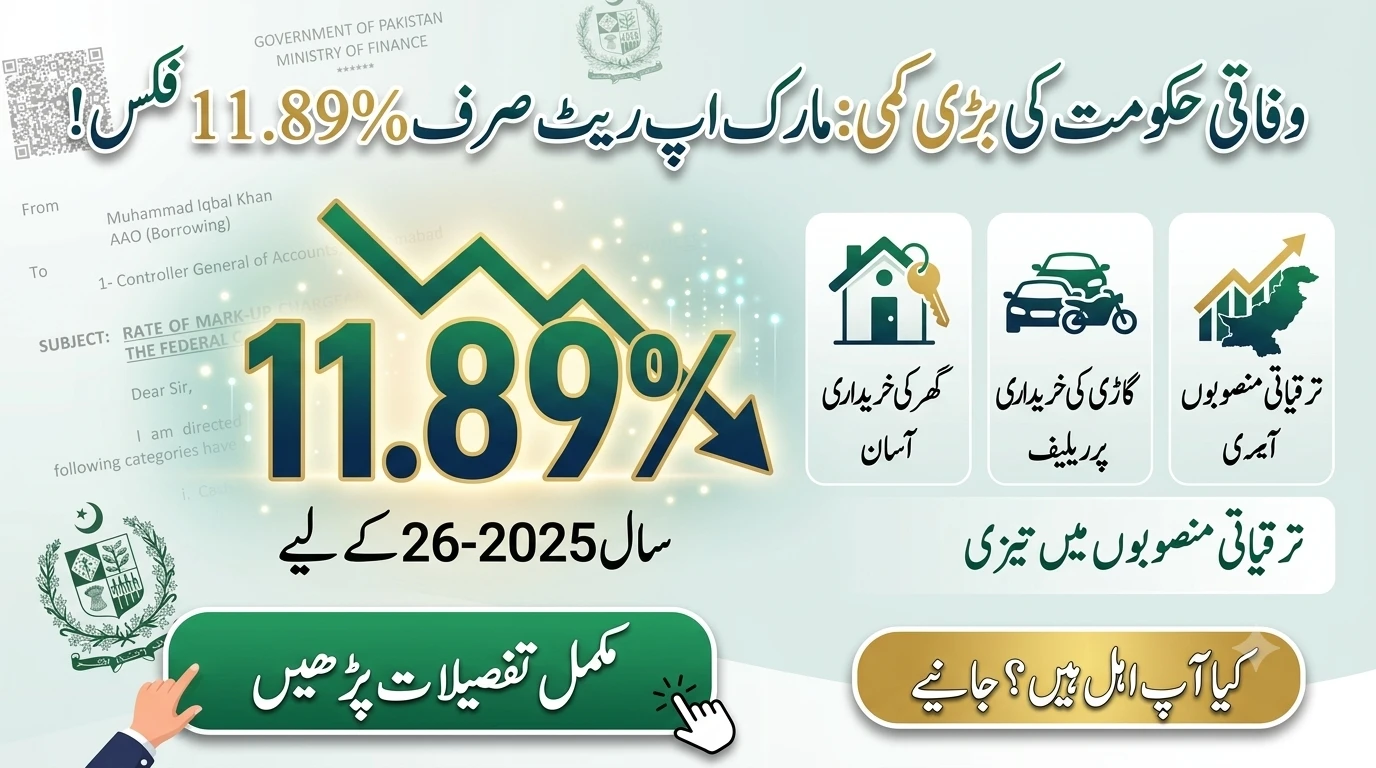
Federal Government Fixes Mark-Up Rate at 11.89% for 2025-26 Loans
The Federal Government recently issued an important notification detailing the financial policies for the new fiscal year. The Ministry of Finance set the final mark-up rate on development loans and advances at 11.89% per annum for the fiscal year 2025-26. This decision brings major relief to various government sectors and public employees.
This new rate represents a massive drop from the rates we saw over the past 2 years. Government employees planning to build homes or buy vehicles will benefit directly from this update. In this article, we will explain exactly what this rate means, who it applies to, and how it impacts different financial departments.
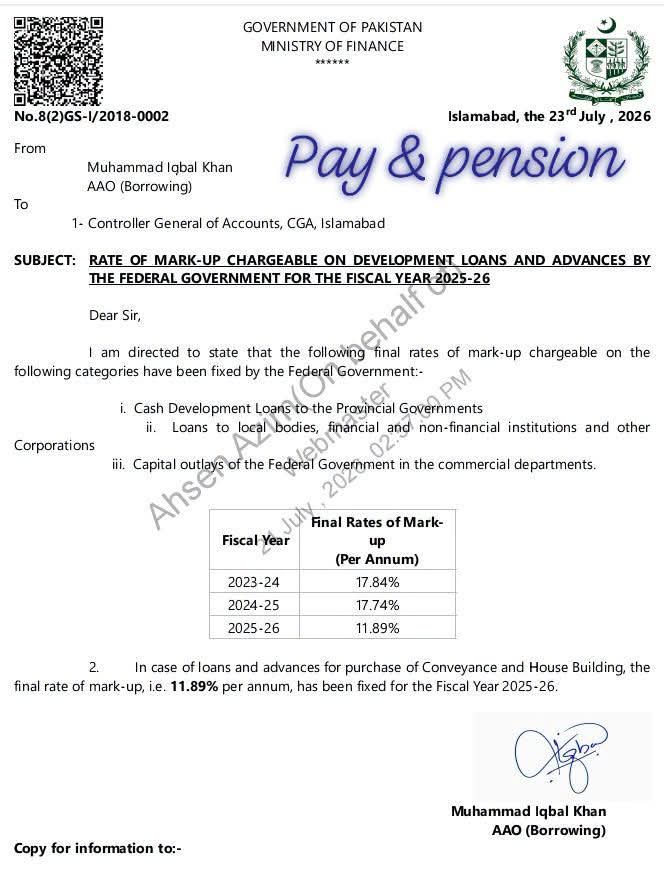
Official Mark-Up Rates Over the Last 3 Years
To understand the value of this new announcement, it helps to look at the historical data. The Ministry of Finance provided a clear comparison of the final rates over the last 3 fiscal years. The steady decline shows a shift toward more affordable borrowing costs for the public sector.
Here are the official rates as released by the government:
- Fiscal Year 2023-24: The rate was 17.84%.
- Fiscal Year 2024-25: The rate decreased slightly to 17.74%.
- Fiscal Year 2025-26: The rate dropped sharply to 11.89%.
This sharp decrease to 11.89% is a highly positive signal. It means the cost of borrowing money from the Federal Government is now much cheaper than it was just 12 months ago.
Categories Covered Under the New 11.89% Rate
The official notification outlines specific areas where this new mark-up rate applies. The Federal Government categorizes its loans to ensure funds are properly managed across different levels of the state. The 11.89% per annum mark-up covers 3 primary categories of government spending.
1. Cash Development Loans to Provincial Governments
Provincial governments rely on federal funds to complete large-scale projects. These cash development loans help provinces build roads, hospitals, schools, and energy infrastructure. With the interest rate dropping to 11.89%, provinces will face lower debt repayment burdens. This allows them to invest more money back into public welfare rather than paying high interest.
2. Loans to Local Bodies and Financial Institutions
The second category includes local municipal bodies, financial and non-financial institutions, and other state-owned corporations. These entities often need federal backing to stay operational or expand their services. A lower rate of 11.89% encourages these local bodies to take on necessary loans without risking financial collapse. It gives public corporations the breathing room they need to operate smoothly.
3. Capital Outlays in Commercial Departments
The final main category involves the capital outlays of the Federal Government within its commercial departments. These are government sectors that run like businesses and generate revenue. Lowering the mark-up rate makes it cheaper for these departments to upgrade their equipment, expand their reach, and improve overall public service delivery.
Relief for Government Employees: Advances for 2025-26
One of the most anticipated parts of this notification relates to government employees. Public servants often rely on government advances to achieve major life goals. The Ministry of Finance clearly stated that the 11.89% mark-up rate also applies to personal staff advances.
House Building Advance (HBA)
Building or buying a house is a major financial milestone. The Federal Government offers a House Building Advance to help employees afford construction costs. For the fiscal year 2025-26, the mark-up on this advance is fixed at 11.89%. Because this rate is nearly 6% lower than last year, employees will save a lot of money on their monthly salary deductions.
Conveyance Advance for Vehicles
Similarly, government workers can apply for a Conveyance Advance to purchase a car or motorcycle. The cost of vehicles has increased rapidly, making this advance very important. By applying the 11.89% per annum rate to conveyance loans, the government is making it easier for staff to afford personal transport.
Economic Impact of the Lower Borrowing Cost
When the Federal Government lowers its internal borrowing rates, it sends a strong message about economic stability. A drop from 17.74% to 11.89% does not happen by accident. It usually reflects broader economic trends, such as reduced national inflation and a stabilized policy rate by the central bank.
For the ordinary citizen, this might seem like internal government paperwork. However, it has a real impact on daily life. When provinces pay less interest on their development loans, they can finish public projects faster. Faster projects mean better roads, upgraded utilities, and more job opportunities at the local level.
How This Benefits the Provinces
Pakistan’s provincial administrations operate on tight budgets. A large portion of their annual budget goes toward servicing debts owed to the Federal Government. The new 11.89% rate gives the provinces a much-needed financial break.
Instead of setting aside massive funds just to clear interest payments, provincial finance departments can now redirect those funds. They can allocate more money to healthcare, education, and public safety. This reduction effectively increases the buying power of provincial governments for the 2025-26 fiscal cycle.
A Positive Step for State-Owned Corporations
State-owned corporations often struggle with high operational costs. Institutions that provide water, power, and logistical services need constant funding. By offering loans at a reduced rate of 11.89%, the Federal Government ensures these corporations do not default on their obligations.
This approach helps prevent the cost of public services from rising too quickly. If a state water or power company has to pay 17.84% interest on a loan, they usually pass that cost onto the consumer. With the interest rate scaled down to 11.89%, these companies can manage their debts without heavily increasing consumer utility bills.
The Role of the Ministry of Finance
The Ministry of Finance issues these notifications annually to keep government accounting transparent. The document dated 23rd July 2026, signed by the AAO of Borrowing, serves as the final legal authority for all federal accounting offices.
The Controller General of Accounts in Islamabad uses these exact figures to calculate deductions, issue funds, and audit provincial books. Without this notification, financial planning for the 2025-26 year cannot officially proceed. The prompt release of this 11.89% rate ensures all government departments can update their ledgers and payroll systems on time.
Summary of Key Takeaways
To wrap up, here are the most important points you need to remember about this financial update:
- The final mark-up rate for 2025-26 is 11.89% per annum.
- This is a significant decrease from the 2024-25 rate of 17.74%.
- The rate applies to provincial development loans, local bodies, and commercial departments.
- Government employees get the same 11.89% rate for House Building and Conveyance Advances.
- The lower rate will help provinces and corporations manage their budgets more effectively.
This policy change will clearly help stabilize public sector spending and provide targeted relief to government staff throughout the upcoming fiscal year.
Frequently Asked Questions (FAQs)
What is the Federal Government mark-up rate for 2025-26?
The Federal Government has officially fixed the mark-up rate at 11.89% per annum for the fiscal year 2025-26. This rate applies to development loans and specific staff advances.
How much did the mark-up rate drop compared to last year?
The rate dropped significantly. In the 2024-25 fiscal year, the rate was 17.74%. It has now been reduced to 11.89% for 2025-26.
Does the 11.89% rate apply to the House Building Advance?
Yes, the official notification confirms that the 11.89% mark-up rate applies to both the House Building Advance and the Conveyance Advance for government employees.
Who benefits from the Cash Development Loans?
Cash Development Loans are primarily issued to Provincial Governments. The lower rate of 11.89% allows provinces to fund infrastructure and public projects at a cheaper borrowing cost.
When was this notification officially issued?
The Ministry of Finance issued this official notification regarding the final rates on the 23rd of July 2026.