Petrol and Diesel Prices Increased in Pakistan (Effective July 24, 2026)
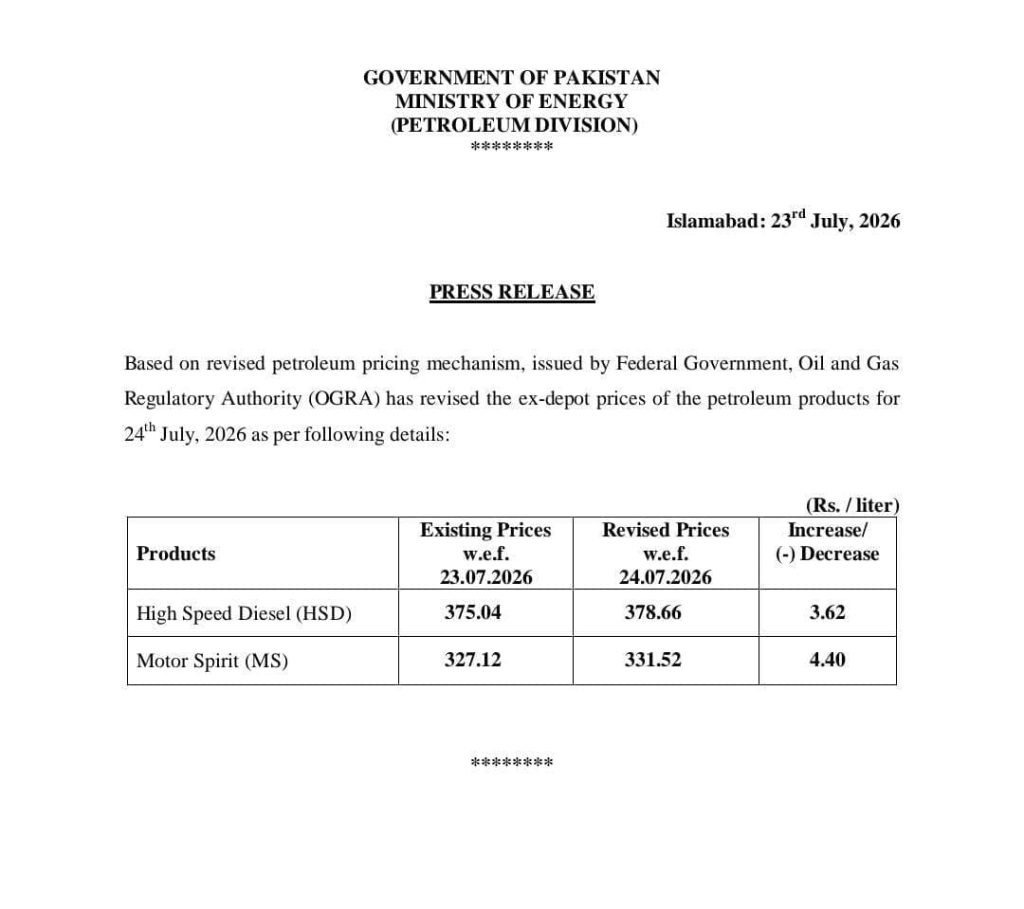
The Government of Pakistan has officially announced a new update regarding fuel costs across the country. Through a press release issued by the Ministry of Energy (Petroleum Division) on July 23, 2026, citizens were informed of an upward revision in the prices of major petroleum products. This change went into effect on July 24, 2026.
For the average citizen, any shift in fuel rates is major news. It directly touches almost every part of daily life. From the cost of your morning commute to the price of fresh vegetables in the local market, fuel prices act as a central driver for the national economy.
This latest update is tied to the revised petroleum pricing mechanism. The Federal Government and the Oil and Gas Regulatory Authority (OGRA) work together to calculate these figures based on various economic factors. In this comprehensive guide, we will break down the exact changes, explore the reasons behind them, and look at how this impacts the common man.
Recent Changes in Petroleum Prices
The most recent notification brings a noticeable hike in the ex-depot prices of both Motor Spirit and High Speed Diesel. These adjustments are now officially implemented at all fuel stations across the nation.
New Price of Motor Spirit (Petrol)
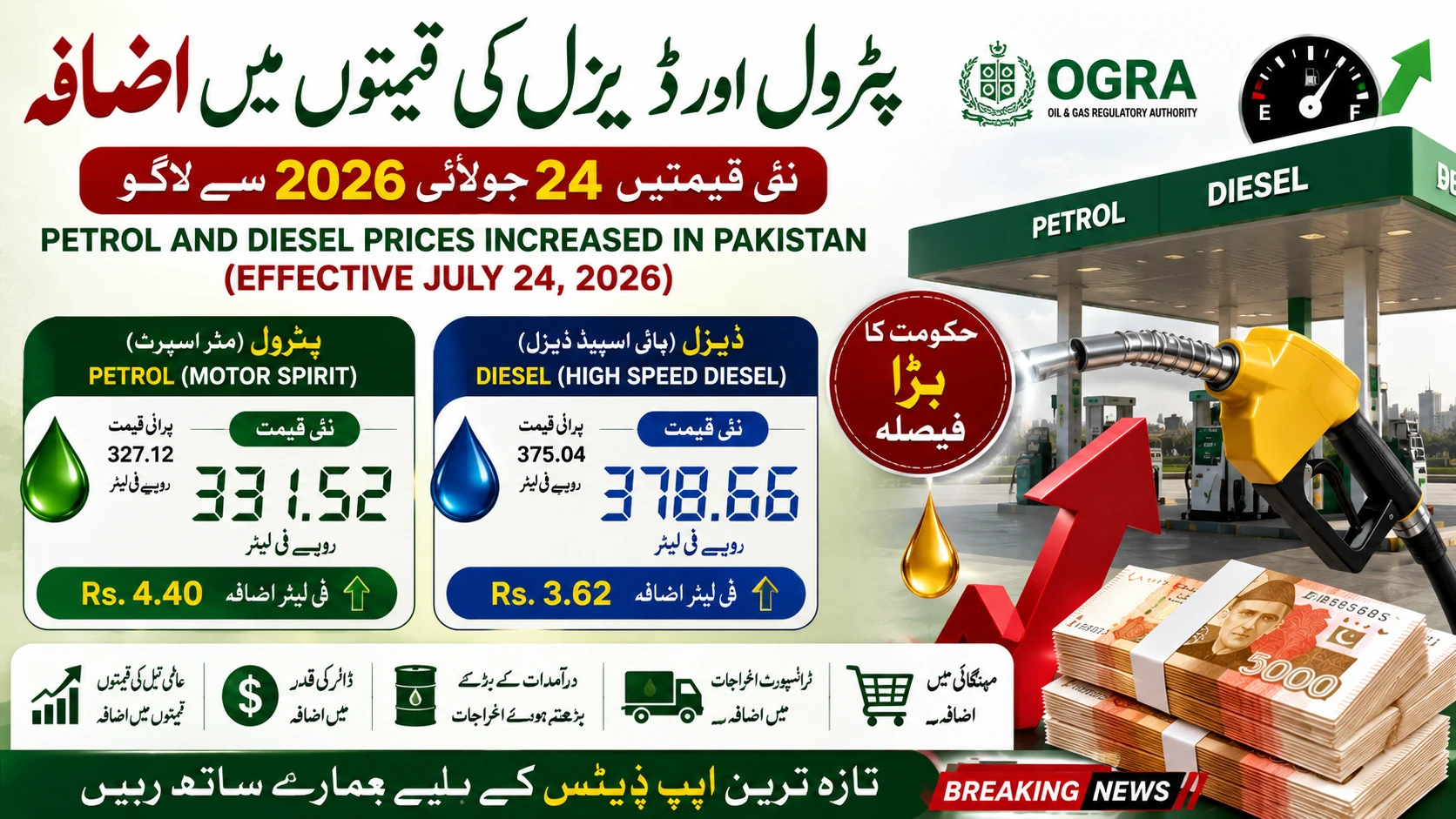
Motor Spirit, commonly known as petrol, is the primary fuel used by millions of motorcycles, cars, and small transport vehicles. The government has increased its price by Rs. 4.40 per liter.
- Previous Price: Rs. 327.12 per liter (as of July 23, 2026)
- New Price: Rs. 331.52 per liter (effective July 24, 2026)
- Total Increase: Rs. 4.40 per liter
This specific increase will be felt immediately by the massive population of daily commuters who rely on personal transport to get to work, school, and run basic errands. It directly affects the monthly budget of middle-class households.
New Price of High Speed Diesel (HSD)
High Speed Diesel powers the heavy lifting of the country. It is the fuel of choice for large transport trucks, passenger buses, and heavy agricultural machinery. The price for HSD has also seen a significant upward shift, increasing by Rs. 3.62 per liter.
- Previous Price: Rs. 375.04 per liter (as of July 23, 2026)
- New Price: Rs. 378.66 per liter (effective July 24, 2026)
- Total Increase: Rs. 3.62 per liter
Because diesel is so heavily tied to the transport of goods, an increase here often has a ripple effect across the broader economy. It makes moving goods more expensive, which usually leads to higher prices for consumers.
Why Do Fuel Prices Change in Pakistan?
Many people wonder why the prices at the pump seem to change so frequently. The reality is that domestic fuel prices are tied to a complex web of local policies and international market trends.
The Role of the Federal Government and OGRA
The Oil and Gas Regulatory Authority (OGRA) plays a crucial role in the energy sector. They are responsible for monitoring the supply chain, tracking international oil markets, and calculating the exact costs of importing and refining fuel.
Once OGRA prepares a working paper with their calculations, they submit it to the Federal Government. The Ministry of Energy, under the guidance of the Prime Minister and the Finance Ministry, makes the final call. They decide how much of the actual cost to pass on to the public and how much to adjust through local taxes or levies.
Understanding the Revised Pricing Mechanism
Historically, Pakistan updated its fuel prices on a fortnightly or weekly basis. However, the system has recently shifted toward a revised pricing mechanism. This new approach allows the government to adjust rates more dynamically in response to immediate market shifts.
By tying the local pump prices closer to real-time international changes, the government aims to prevent massive financial losses in the energy sector. While this means prices can go up quickly, it also means that drops in the global market can be passed on to the consumer much faster.
Global Oil Market Influence
Pakistan imports the vast majority of its petroleum products. Therefore, the country is highly exposed to the international oil market. When global crude oil prices rise due to geopolitical tensions, supply chain disruptions, or increased global demand, the cost of importing that oil goes up.
Even minor conflicts in major oil-producing regions can cause immediate spikes in global prices. Pakistan must buy fuel at these elevated international rates, which ultimately translates to higher prices at your local petrol pump.
Currency Exchange Rates
Another massive factor is the strength of the Pakistani Rupee against the US Dollar. International oil trades are conducted in dollars. If the value of the rupee falls, it takes more local currency to buy the exact same amount of oil.
Therefore, even if the international price of crude oil stays completely flat, a weaker local currency will force domestic fuel prices upward. Economic stability and a strong exchange rate are vital for keeping fuel costs manageable for the general public.
How This Price Hike Affects Daily Life
A rise in the petrol price in Pakistan is never just about filling up your car. It is an economic event that touches every single household, regardless of whether they own a vehicle or not.
Impact on Public and Private Transportation
The most immediate and obvious impact is on transportation. For private vehicle owners, the monthly budget for commuting just got tighter. People who drive to work every day will have to allocate more of their salary to fuel expenses, leaving less room for savings or leisure activities.
Public transport users are also affected. Bus operators, rickshaw drivers, and ride-hailing services face higher operating costs. Eventually, these costs are passed down to the passengers in the form of increased fares. Traveling from one city to another, or even just across town, becomes an added financial burden.
Rising Costs of Goods and Groceries
High Speed Diesel is the lifeblood of the logistics industry. Every single item you see in a grocery store, from flour and sugar to fresh fruit and vegetables, is transported by diesel-powered trucks from farms and factories to urban centers.
When the cost of diesel goes up by Rs. 3.62 per liter, the cost of moving goods across the country increases. Retailers and distributors naturally adjust their prices to maintain their profit margins. This leads to a general rise in inflation, making basic necessities more expensive for the average family.
Effects on the Agriculture Sector
Pakistan is heavily reliant on its agriculture sector. Farmers use diesel to power their tractors for plowing fields and harvesting crops. They also rely on massive diesel generators to run tube wells for irrigation, especially in rural areas that suffer from unreliable electricity.
Higher diesel prices mean a higher cost of production for farmers. This not only cuts into the already tight margins of the agricultural community but also contributes directly to higher food prices in urban markets. The entire food supply chain becomes more costly to operate.
Small Businesses and Operating Expenses
Small business owners also feel the pinch of these frequent fuel hikes. Many local shops and small manufacturing units use fuel-powered generators as a backup during power outages. An increase in petrol and diesel prices dramatically raises their daily operating costs.
Additionally, businesses that offer local delivery services will have to spend more to get their products to their customers. This can force small businesses to either raise their prices or absorb the financial losses, both of which can stunt local economic growth.
Effective Ways to Manage Rising Fuel Costs
While citizens cannot control the national fuel rates, there are several practical steps everyone can take to reduce their personal fuel consumption and save money during these expensive times.
Adopting Better Driving Habits
How you drive has a massive impact on your overall fuel efficiency. Aggressive driving, rapid acceleration, and hard braking consume significantly more fuel than a calm driving style.
By driving smoothly and keeping your speed consistent, you can greatly improve your vehicle’s mileage. Using the correct gear and avoiding unnecessary idling at traffic lights can also save precious drops of fuel every single day.
Carpooling and Public Transport
One of the most effective ways to cut costs is to share the journey. If you and your colleagues live in the same area, taking turns driving to work can cut your monthly fuel bill in half while reducing traffic congestion.
Where available and safe, using public transportation like metro buses or regional trains is vastly cheaper than using a personal vehicle. As fuel prices continue to rise, public transit becomes a much more attractive and economical option for daily commuting.
Regular Vehicle Maintenance
A poorly maintained vehicle burns far more fuel. Simple, routine maintenance tasks can vastly improve your car or motorcycle’s efficiency and save you money in the long run.
- Keep your tires properly inflated to the recommended pressure.
- Change your engine oil and air filters regularly according to the manual.
- Ensure your engine is properly tuned by a qualified mechanic.
These small investments in regular maintenance pay for themselves by providing significantly better mileage at the pump.
Planning Trips Efficiently
Try to combine your errands into a single trip rather than making multiple short journeys. An engine runs most efficiently when it is warmed up to its optimal operating temperature. Several short trips starting with a cold engine will use much more fuel than one longer, continuous trip.
Planning your route in advance to avoid heavy traffic and road closures can also prevent you from burning fuel while sitting completely still on the road.
The Future of Fuel Pricing in Pakistan
The energy sector in Pakistan is undergoing significant structural changes. The shift toward a revised daily pricing mechanism indicates that the government wants a more responsive economic model that mirrors global trends.
Transition to Daily Adjustments
By moving away from long-term fixed pricing, the system is becoming slightly more transparent. Consumers will start to see that local prices are a direct reflection of international realities. While this takes away the certainty of fixed monthly budgets, it stops the massive buildup of circular debt in the broader energy sector.
Need for Renewable Energy Sources
The continuous cycle of rising fuel prices highlights a much deeper, structural issue: Pakistan’s heavy reliance on imported fossil fuels. For long-term economic stability, there must be a strong push toward affordable renewable energy.
Investing in solar power, wind energy, and the infrastructure for electric vehicles (EVs) is absolutely essential. A gradual shift away from traditional petrol and diesel will protect the local economy from the unpredictable shocks of the global oil market.
Frequently Asked Questions (FAQs)
When did the new petrol prices take effect?
The revised prices for Motor Spirit (petrol) and High Speed Diesel (HSD) officially came into effect on July 24, 2026.
How much did the petrol price increase?
The price of Motor Spirit (petrol) increased by Rs. 4.40 per liter, bringing the new price to Rs. 331.52 per liter.
What is the new price of High Speed Diesel (HSD)?
The price of High Speed Diesel increased by Rs. 3.62 per liter. The new rate is officially set at Rs. 378.66 per liter.
Who decides the fuel prices in Pakistan?
The Oil and Gas Regulatory Authority (OGRA) calculates the base prices based on international markets, and the Federal Government (Ministry of Energy) makes the final decision and issues the official notification.
Why are prices changing so frequently?
The government has adopted a revised petroleum pricing mechanism. This system adjusts local prices more dynamically to accurately reflect the fast-changing trends in the global oil market.